
By Niémah Davids
Photos taken by Lerato Maduna
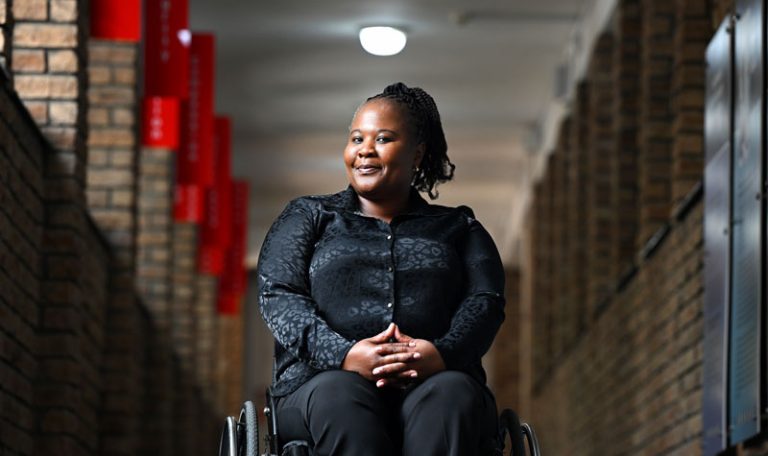
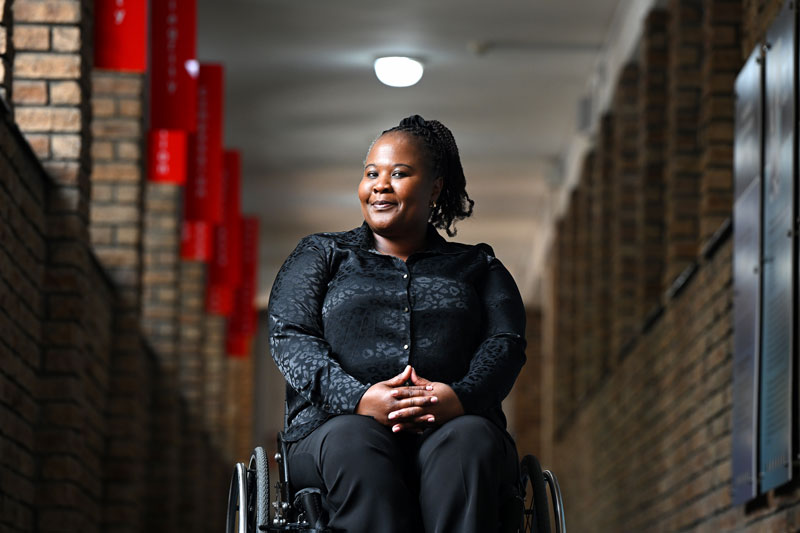
Life has dealt Ncikazi Nyoka a difficult hand. In 2009, a car accident robbed her of her ability to walk, leaving her with a lifelong disability. But that wasn’t the worst part. When her husband filed for divorce because helping to care for her after her accident was just too much, she hit rock bottom. But as they say, adversity breeds strength.
“That was the worst moment of my life. But I had to keep going. I had two young daughters who depended on me and I couldn’t let them down. My girls are my everything. After my divorce, their encouragement and support carried me. I am because of them,” she said.
It is thanks to their motivation and love and her nerves of steel that Ncikazi will graduate with a master’s in disability studies from the University of Cape Town (UCT) on Wednesday, 9 September. It’s been a rough ride, but she’s been in it for the long haul and she has finally completed the race.
Research in brief
Before starting her master’s, Ncikazi, a social worker, worked in the non-governmental (NGO) sector, mainly with organisations of persons with disabilities (OPD). These organisations, she explained, have been set up to advocate for equal inclusion, and promote, protect and defend the human rights of people living with disabilities in South Africa.
This working experience opened her eyes to different challenges that people living with disabilities face, including limited access to learnership programmes and employment opportunities. Learnership programmes are crucial for people living with disabilities, as it provides skills development and readies them for a world of work. Eager to seek answers to several questions, Ncikazi enrolled for her master’s and directed her research to the subject. In brief, her research focused on how young adults living with disabilities transition from special needs schools to learnership programmes and ultimately into the workplace, and the barriers they face.
Ncikazi’s research found that multiple barriers prevent the youth from accessing learnership programmes. These include a lack of finance, infrastructure that fails to accommodate their needs and a lack of overall guidance and support on the best learning avenues to pursue. This, she said, hampers their employability and stifles their development.
“People living with disabilities have dreams and aspirations. Like everyone else, they have hopes of succeeding in life. To ensure this becomes a reality, we have to make every effort to ensure they receive the right guidance to access learnership programmes. And these learnerships need to be adequately funded by government,” she said.
Empowering people living with disabilities
Having witnessed first-hand the challenges people living with disabilities face, Ncikazi was determined to make a difference. So, she got to work and co-founded a consultancy, New Hope for Disabilities, earlier this year. The business provides mentorship and training for young entrepreneurs living with disabilities. The organisation also offers skills development and job-readiness programmes, assists participants with sourcing job opportunities that fit their skill set, and offers counselling and psychosocial support.
The consultancy’s goal, Ncikazi explained, is to develop a pipeline of skilled individuals living with disabilities who can successfully contribute to the workforce, as well as the local economy. The business has recently partnered with several private sector organisations to create a feeder system for employment, with a focus on persons living with disabilities. They’ve also developed a disability sensitisation programme, which will be rolled out to companies that employ people with disabilities.
“Far too many talented individuals with disabilities, especially in the youth category, remain unemployed, and we needed to do something about it. Our programmes are tailored to fit skilled and unskilled individuals’ needs and to empower them the best way we know how,” she said.
“We believe that people with disabilities have so much to contribute to our society. But there are barriers that hinder their participation. We need to focus on removing these barriers so that they are able to participate fully in society.”
A journey of becoming
Though passionate about her research and the importance of empowering people living with disabilities, Ncikazi said completing her master’s was not easy. But the journey, which kicked off during the height of the COVID-19 pandemic, taught her more about herself than she “could ever have imagined”. She said she quickly learned how to balance the demands of her course with being a single mother and tending to her daughters’ needs; caring for her ill mom; and full-time employment. And it was tough. But throughout, she said, she kept her eye on the prize, prioritised self-care and enjoyed regular alone time for some reflection and introspection.
Reflecting on her master’s, Ncikazi has high praise for her supervisors, Sumaya Gabriels and Professor Theresa Lorenzo, in the Division of Disability Studies. Their support and encouragement ushered her through the highs and lows of her degree. Her academic mentors within the division, Dr Mzolisi Toni and Dr Kofi Nseibo, also provided regular guidance and advice. Not forgetting her mom and daughters, who she described as her biggest cheerleaders. She also spoke with fondness of her peers, who were a constant source of motivation and provided good comic relief when things weren’t going according to plan.
“This really has been a journey of becoming. I became wiser, learned to understand myself better and to understand the needs of people living with disabilities so much better. This degree has opened my eyes to a whole new world,” she said.
“I am excited for what the future holds, and who knows, it might include a PhD.”