
Story: Myolisi Gophe. Photos: Lerato Maduna.
When meningitis robbed him of his hearing at the age of eight, many believed Ibrahim Tukur’s future had been written off. His teachers could no longer reach him. Friends drifted away. Some mocked him. Even his father, convinced there was no future for a deaf child, withdrew him from school.
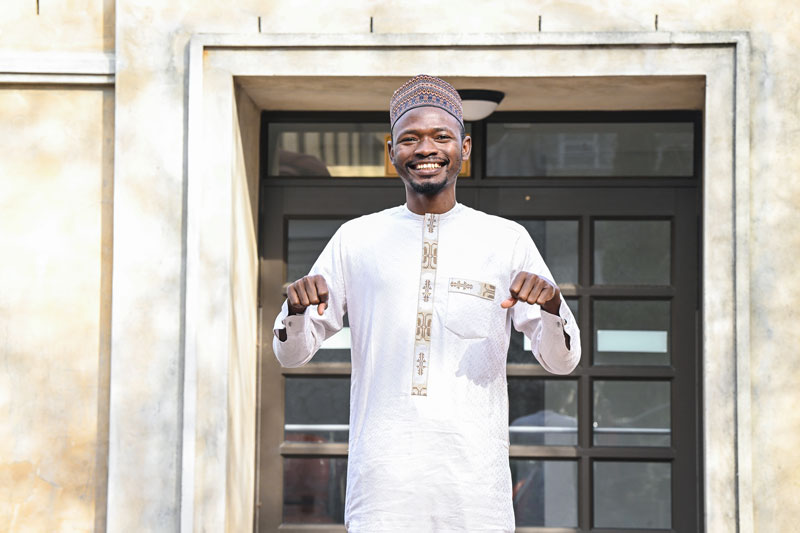
Today, that same boy is pursuing a Master of Philosophy (MPhil) in Disability Studies at the University of Cape Town’s (UCT) Department of Rehabilitation and Health Sciences as the first Deaf Mandela Rhodes Scholar – one of Africa’s most prestigious leadership scholarships – and is using his experiences to advocate for a more inclusive society.
For Tukur, who hails from Nigeria, his journey is not simply one of overcoming adversity – it is proof that when barriers are removed and opportunities are created, people with disabilities can thrive.
“Receiving the scholarship was one of the happiest moments of my life,” he said. “It reminded me that our disabilities do not determine our success.”
Growing up in Ingawa, a small town in Nigeria’s Katsina State, life changed overnight when meningitis left him Deaf.
Unable to follow lessons in mainstream classrooms, he experienced a sharp decline in academic performance.
“My life drastically changed,” he recalled. “I could no longer understand what my teachers were teaching.”
The social isolation that followed was equally devastating.
“I lost most of my friends, who avoided me because of my deafness, as if it were a curse.”
Believing there was little hope for his son’s future, his father removed him from school.
But fate intervened.
A relative encouraged his father to enrol him at the Government School for the Deaf in Malumfashi, a residential school where sign language was the primary means of communication.
The impact was immediate.
“For the first time since losing my hearing, I learned in an environment where everyone communicated through sign language. Gradually, I regained my confidence, rediscovered my love for learning, and began to believe in myself again.”
That experience sparked a lifelong commitment to ensuring other Deaf children would not face the same barriers.
He went on to earn a degree in Special Education from Bayero University in Kano before enrolling at UCT to deepen his understanding of disability inclusion and advocacy.
Today, he serves as the head teacher at Dambo Tukur School for the Deaf and he also co-founded the Thrive Disability Initiative, a non-governmental organisation (NGO) dedicated to empowering persons with disabilities through education, employment, and entrepreneurship.
Finding inclusion at UCT
Although he had spent years advocating for disability rights, arriving at UCT introduced him to a level of inclusion he had never previously experienced.
“I have never experienced what real inclusion was like until I came to UCT,” he said.
When he struggled to find accommodation upon arrival, staff at UCT’s Disability Service stepped in immediately, helping secure accessible accommodation at Obz Square in Observatory and installing assistive technologies in his room.
Initially, he worried he might be inconveniencing others.
“I realised that inclusion is not about doing someone a favour. It is about removing barriers so everyone can participate equally.”
Another turning point came when his South African Sign Language interpreter connected him with members of the Western Cape Deaf community.
“Through them, I found friendship, belonging and a sense of home.”
Those experiences reinforced his belief that leadership begins by creating spaces where everyone feels seen, valued and included.
The importance of leadership
The Mandela Rhodes Scholarship recognises more than academic excellence. It seeks young leaders committed to reconciliation, entrepreneurship and social impact.
For him, leadership has always been measured by how many lives are impacted, rather than what titles people have.
Among his proudest achievements is advocating for the establishment of Dambo Tukur School for the Deaf back home, which now provides quality education to more than 50 Deaf children who previously had little or no access to schooling.
He has also organised mentorship programmes for Deaf learners, trained government workers in sign language to improve communication with Deaf citizens and coordinated vocational skills programmes that have enabled many unemployed Deaf adults to become financially independent.
One of his biggest challenges came while campaigning for the school.
Government officials initially resisted the proposal because of misconceptions about Deaf people.
Rather than allowing disagreement to create division, he chose dialogue.
“By continuing to engage respectfully and demonstrating the importance of inclusive education, we eventually secured approval and established the school.”
He believes those experiences embody the leadership values championed by the Mandela Rhodes Foundation.
Overcoming invisible barriers
His own university experience also revealed the everyday obstacles Deaf students continue to face.
As an undergraduate, before his journey with UCT, he completed his degree without the support of a sign language interpreter.
Instead, he relied on lecture notes, handouts, and hours of independent study to compensate for the information he could not access in class.
“There were moments when I questioned whether I truly belonged at university and whether I could succeed in a system that was not designed with Deaf students in mind.”
Despite those challenges, he graduated with an Upper Second Class pass (an average score between 60% and 69% across his university courses).
The experience shaped his conviction that disability itself is not the greatest obstacle.
“Inaccessible environments create the greatest barriers to success.”
As someone who has lived the realities of exclusion, he believes universities have an important role to play in changing society.
He would like to see disability studies integrated across disciplines so that graduates in every field understand disability rights, accessibility, and inclusive communication.
He also advocates for stronger support services, including timely access to sign language interpreters, assistive technologies and accessible learning materials.
Financial support for students with disabilities, particularly those from disadvantaged backgrounds, is equally important.
Long-term vision
His long-term vision is ambitious: over the next decade, he hopes to empower at least 500 people with disabilities through education, leadership development and entrepreneurship.
The Mandela Rhodes Scholarship, he said, provides more than financial support.
“It gives me the knowledge, networks and leadership experience to achieve these goals.”
Looking back on his journey, he hopes his story inspires other Deaf learners to believe in themselves.
“Do not allow society’s expectations to define your future,” he said.
“There will be obstacles, and there may be moments when people underestimate your abilities, but your deafness does not determine your intelligence, your talent or your potential.”
His message is simple but powerful.
“If a boy who was once withdrawn from school because people believed he had no future could become a Mandela Rhodes Scholar and study at one of Africa’s leading universities, then you should never doubt what is possible for your own life.
“Dream boldly, persevere through challenges, and remember that you deserve to learn, to lead and thrive just like everyone else.”